Dojo Award Studio · buyer guide
Belt display headers versus complete belt racks
For Dojo Award Studio buyers worldwide, a belt-display quote should specify whether you need a personalized header, separate belt holders or a complete assembly. A header names the display; it does not automatically include every part needed to hold the belts. List existing components and request the complete included scope before comparing prices.
Reviewed 2026-09-05 · AI-assisted editorial review. General buying guidance; illustrative scenarios are not customer case studies. Images are AI-generated concepts.
Can a new header fit an existing belt rack?
Start with the actual location and any parts already owned. A family replacing a personalized header has a different brief from a dojo commissioning a new display from scratch. Photographs can show the arrangement, but measurements and component identification are needed to establish how a new piece might relate to it.
Do not assume that two products described as belt displays share compatible connections. A new header may need a different attachment pattern or may not be designed to carry existing planks. Ask production to review the actual interface. The buyer should not discover after delivery that the attractive name panel has no agreed way to connect to the rack beneath it.
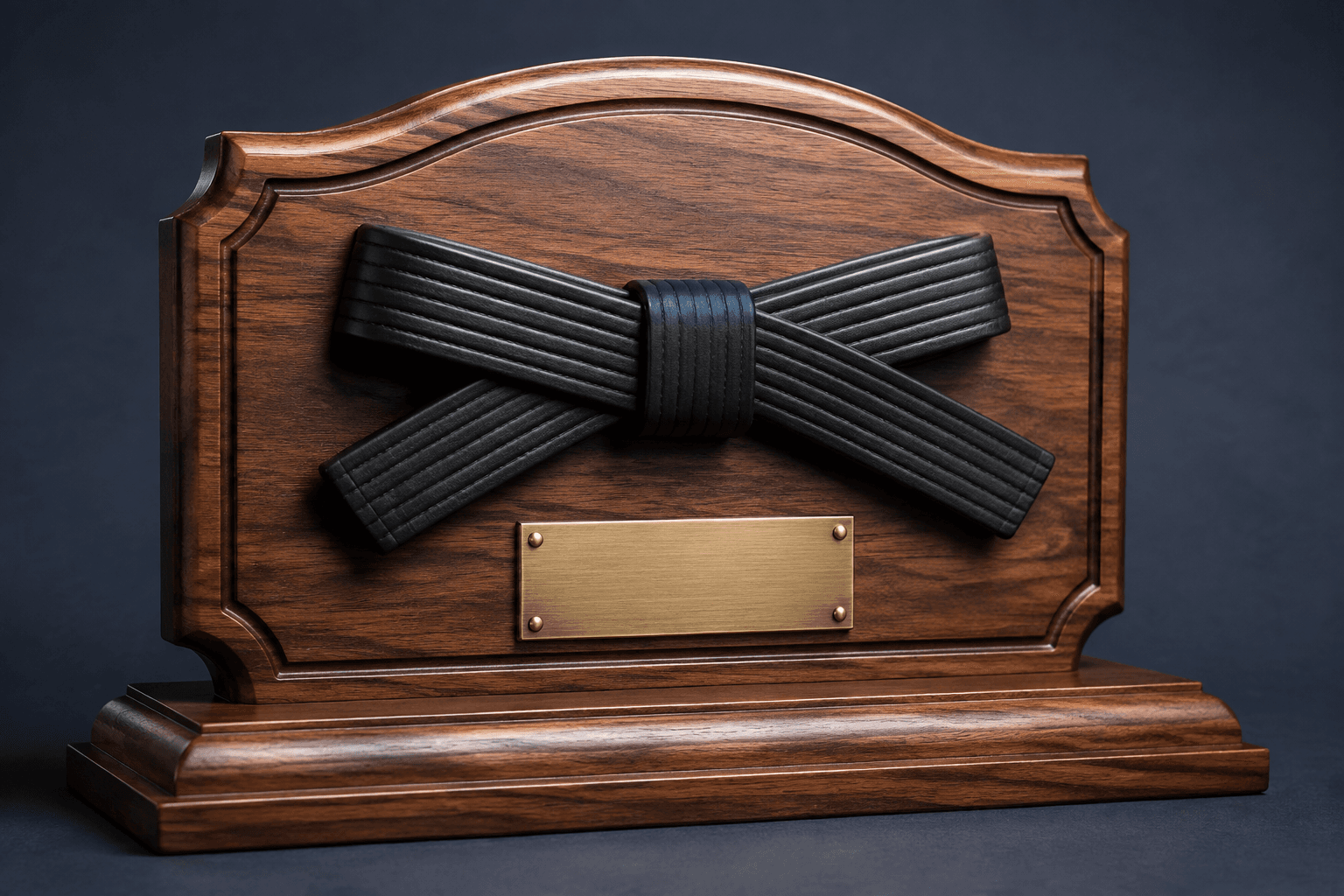

What parts belong in a complete belt-display quote?
Write the intended contents as physical items: personalized header, belt-holding rows or other specified holders, any approved connectors and the mounting components included in the proposal. Keep the belt collection itself separate if the buyer supplies it. A photo showing belts on a rack does not mean belts are part of the purchase.
Ask the quote to identify optional and included parts. A header-only price can be useful for someone reusing a confirmed compatible display, but it is not comparable with a complete assembly price until their scopes are reconciled. Use the actual proposed component list rather than an ambiguous phrase such as deluxe set.
Allied lists header-only and header-with-plank display options.
What should the belt-display header say?
The header can emphasize the student's approved display name, a milestone or the dojo identity. A family may want a lasting personal record, while a dojo may want a shared teaching display. Those purposes can lead to different wording and ownership even when the physical structure is similar.
Do not engrave an unverified rank simply because a catalog example includes one. The instructor or authorized rank-record owner should approve any achievement terminology. If the display is intended to grow over time, consider whether an undated personal header is more appropriate than a statement tied to one promotion. That is a wording choice, not a prediction of future rank.


Which belt measurements does a display need?
Record the belts' relevant dimensions in the intended folded or displayed arrangement. Belts in one collection can differ in width, thickness or length, so a sample from a different student may not establish the requirements. Keep measurement units explicit and note any decorative embroidery or thick section that affects placement.
Ask the proposed display maker which dimensions determine the holder or row arrangement. Do not treat a count of belts as a complete fit specification. Six belts tell you the inventory; the actual measurements and display method tell the designer how that inventory needs to be accommodated. Keep those two questions separate in the worksheet.
Count header and belt-holder components
For the illustrative component set, enter six belt-holding rows and one additional header. The calculator returns seven physical components. That result does not mean seven complete displays and does not confirm the holder dimensions, connections or mounting arrangement. Use the worksheet to keep the proposed assembly and its parts clear.
Method: Multiply units by pieces per unit, then add separately entered categories and explicitly chosen spares. No eligibility or spare allowance is inferred.
Build your plan
Set spares yourself. This calculates the quantities you enter; it does not assume a recommended buffer.
Use the article’s example files
Sample rows are fictional planning examples. Replace them with authorized information and retain the approval references privately; this file is not a production release.
How much wall space will the complete display use?
Show the desired arrangement for the belts already approved for display. If the buyer wants room for future additions, label those positions as reserved rather than filling them with assumed rank names. The display can anticipate physical capacity without making a claim about a student's future progression.
A header with a certain width does not automatically establish the total wall area required by a multi-row assembly. Ask for the complete proposed dimensions, including the header, holders, gaps and any attachment areas. Review that outline against the actual location so the buyer understands how the finished display occupies the room.

Who installs a gifted belt display?
The proposal should state the intended mounting arrangement and what is included. The installer or appropriate responsible contact needs to review the actual wall or support conditions. A generic material description does not establish that a particular fastener or location is suitable.
For a family gift, identify whether the recipient expects a ready-to-install assembly or a collection of parts requiring further decisions. Do not assume a gift recipient has agreed to drill holes or assemble an unfamiliar rack. The buyer can choose a different display arrangement if the installation burden does not fit the intended use. Resolve that before ordering personalized parts that are difficult to repurpose.
Can the display expand later?
A display described as expandable should have a confirmed method for adding components. Ask which parts can be added, how the connection works and whether a later addition changes the complete dimensions or mounting requirements. Do not assume unlimited growth or permanent availability from a product name.
A fixed assembly may be simpler when the buyer has a defined collection and display area. An expandable arrangement may suit a different brief, but it creates future component and installation decisions. Compare those responsibilities with the buyer's actual plans rather than selecting expansion solely because more capacity sounds better.
Does text approval also approve the rack?
The student's name can be approved while the assembly dimensions remain unresolved, and the reverse is also possible. Mark those statuses separately. A proof of the header text does not approve the rack's complete construction, while a measured assembly drawing does not verify the spelling of the name.
Before release, connect the two approved records to the same order revision. If a different header size is selected to fit the assembly, review the text layout again. If the inscription changes substantially, confirm that it still fits the approved header. The final purchase should describe one coherent object rather than two unrelated approvals.
How do you check a delivered belt-display set?
At receiving, compare the actual parts with the written scope. Check the header personalization, the number of belt-holding components and any included mounting or connection items. A correct package count does not establish that a complete display has arrived. Keep the parts identified until the authorized assembly review is complete.
If an item is missing or does not match the agreed interface, request a specific correction before improvising a connection. The buyer should not drill or alter a personalized component simply because it nearly fits the old rack. A small mismatch can change the intended construction and should be reviewed by the appropriate production contact.
What should you save for a matching reorder?
Save the final component list, approved dimensions, personalization proof and installation instructions with the order reference. A second display for another student can then begin from known information while still requiring that student's actual name and belt measurements. Similar purpose does not mean identical physical requirements.
If the first display is used as a reference, describe it as an approved prior configuration rather than a universal standard. The next buyer may have a smaller wall area or a different collection. Keep the reusable design principles while checking the changed facts. That approach preserves consistency without turning the first student's measurements into an unverified assumption for everyone else.
How does the illustrative planning example work?
A fictional buyer already owns a reviewed compatible rack and orders one new personalized header. The purchase contains one piece. A different buyer requests one header plus six separately specified belt-holding rows, giving seven physical components: units 6, each 1, extras 1 and spares 0.
The calculator's seven-piece result is a component count, not seven complete displays. The worksheet labels the header and rows separately and leaves mounting details pending because no real location or construction has been assessed.
If the written proposal instead supplies one factory-complete assembly, record the purchased assembly as one item with its included components described beneath it. Do not add seven components to one assembly and call the result eight displays. The purchase unit and component inventory must be clear enough that the quote and receiving check describe the same scope.
Which option matches the approved purpose?
Choose a header-only order when a compatible existing rack needs a new identity piece. Choose separate components or a complete assembly when the belt-holding structure must also be supplied. The meaningful comparison is the complete included scope, with fit, assembly and mounting responsibilities stated before the buyer approves the price.
| Option | Useful when | Decision to resolve |
|---|---|---|
| Header only | A compatible existing display is being personalized or refreshed. | Confirm the actual connection and included scope. |
| Header plus separate holders | The buyer is commissioning an explicitly specified component set. | Count components and assign assembly responsibility. |
| Complete display assembly | The proposal supplies the agreed working display as one assembly. | Confirm included parts, full dimensions and mounting arrangements. |
What should you know before ordering?
Before ordering a belt display, establish the purchase unit, the actual belt arrangement and who will install the finished piece. A component count does not establish compatibility or a complete assembly. The questions below explain the quote boundaries and the information needed to avoid an unexpected installation or missing-part problem.
How is a header-only quote different from a complete-rack quote?
Compare the quoted purchase unit and included components. A header-only scope can omit belt holders, connectors or mounting items that a complete display needs. Ask Dojo Award Studio to identify the actual proposed dimensions, personalization, components, packing and delivery scope before comparing the total with another configuration.
Can a personalized header hold the belts by itself?
Use the actual proposed specification. A header can be an identity component rather than a complete belt-holding system. Ask which holders and connections are included and how the finished arrangement is intended to work. Do not treat belts shown in a concept image as included merchandise or proof of the assembly.
Can a new header fit any existing rack?
Compatibility needs review against the actual dimensions and connection arrangement. Supply a measured drawing and clear photographs of the existing parts. Similar width or appearance does not establish fit, and the buyer should not drill or alter a personalized component to solve an unreviewed mismatch.
Does seven components mean seven complete displays?
No. One header and six separate holders can form one proposed display. The calculator counts the physical components entered, while the quote must identify the purchase unit. If production supplies one complete assembly, record that assembly and describe its included parts without counting it again as extra displays.
What must be confirmed before ordering a gift display?
Confirm the recipient’s approved name, actual belt arrangement, available display area and installation expectations. The text proof and the component specification need separate approval. A gift should not arrive with an unexpected mounting or assembly task that the buyer never discussed with the recipient or responsible installer.
Sources and scope
The sources below support the cited technical details. The ordering workflows are editorial recommendations. Your project specification, price and schedule are established in the written quote and approved proof.
- Allied Medal Hangers: Custom Belt Display Header · checked 2026-09-05
Which buying guide should you read next?
All buying guidesRecord the actual belts, folding arrangement and available display area separately, then ask for a measured proposal that connects those facts to the complete display.
Coordinate a multi-dojo order through one shared item schedule, with separate rank approvals, exact names, destination quantities and receiving owners for every location.